Thrips
Order Thysanoptera (thrips)
Family Thripidae
Species Thrips tabaci (onion thrips)
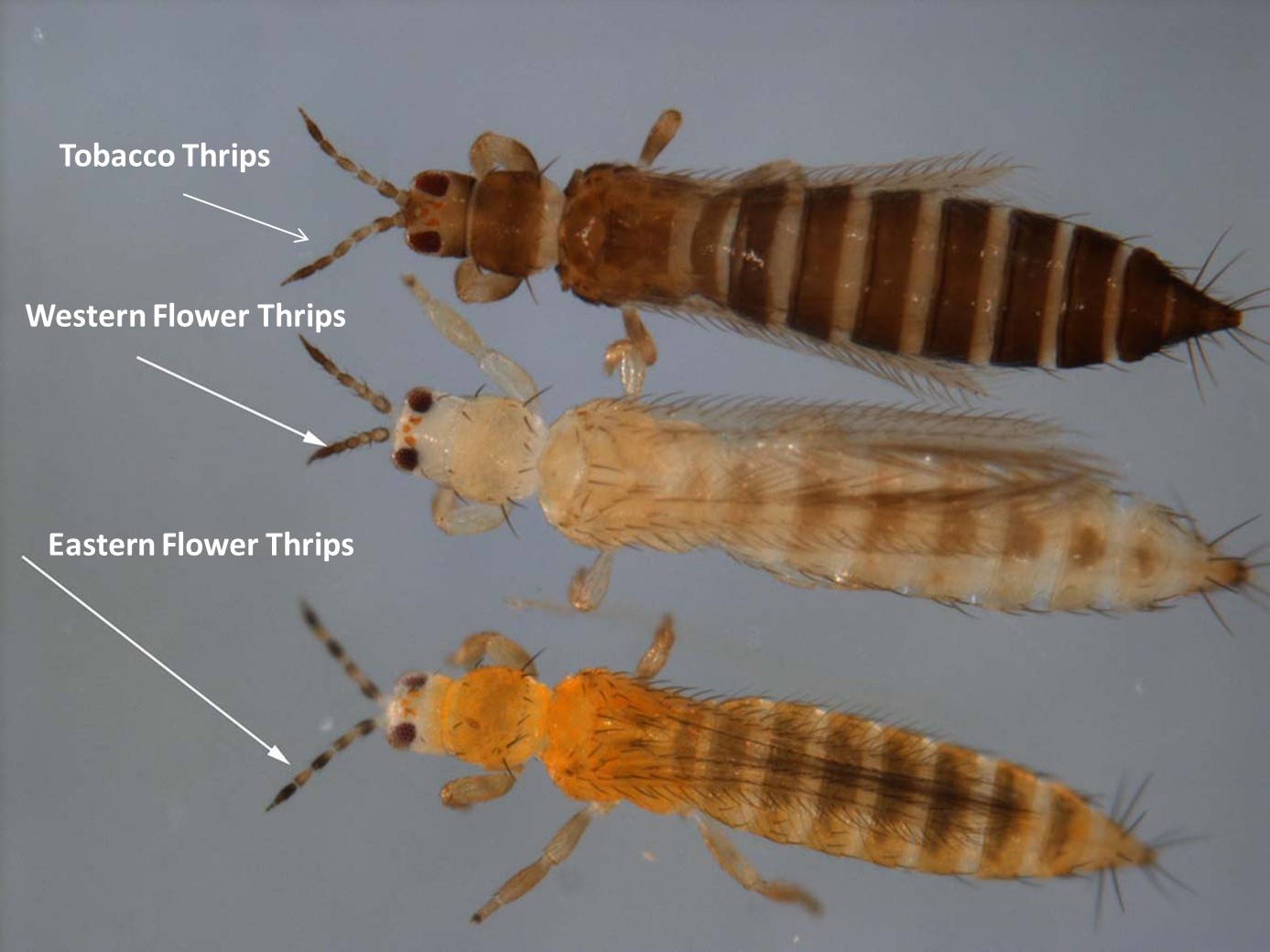
Species Frankliniella fusca (tobacco thrips)
Species Frankliniella occidentalis (Western flower thrips)
Species Frankliniella tritici (Eastern flower thrips)
Description
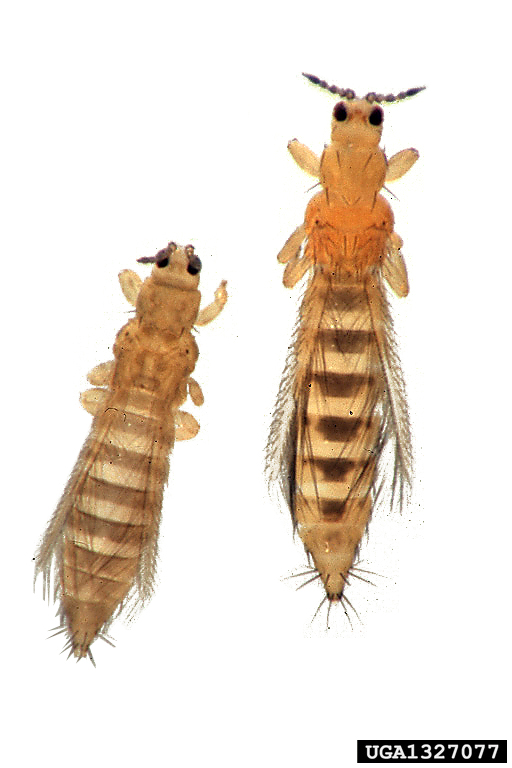
Thrips, including onion thrips (Thrips tabaci) are an important annual pest of onion. They may attack nearly all garden crops, but serious damage is generally limited to onions, cauliflower, cabbage, cucumber, and tomatoes. Adult onion thrips are about 1/12” long, thin, and pale yellow to brown in color. Their wings have no veins and are fringed with long hairs. Nymphs resemble adults except they are smaller and lack wings.
Symptoms and effects
Onion: Mass immigration to onion fields can occur any time throughout the summer, but is likely coincident with harvest of infested legume and grain fields. Feeding damage causes whitish blotches and dry, yellow areas on leaves, decreased pollen set, and, under heavy infestations, brown leaf tips and distorted or undersized bulbs. Both adults and larvae can cause silvery streaking on leaves, which becomes dry and yellow. Immature thrips prefer to feed on the youngest leaves. Red onions are particularly susceptible, while Spanish onions tend to be somewhat resistant.
Cabbage: Since thrips prefer tight spaces, cabbage varieties with extremely dense heads are most susceptible to damage. Thrips are often found several layers deep within developing cabbage heads. Heavy thrips buildup may cause the cabbage head to become distorted. Cultivars with leaves tightly held to stem are more susceptible to thrips damage, while cultivars with more open growth, circular leaf structure, and glossy foliage suffer less damage.
Cauliflower: On cauliflower, thrips damage causes tan or brown streaks on the curd. Damaged curds are more susceptible to soft rot bacteria.
Thrips are also vectors of plant viruses such as the Tomato spotted wilt virus.
Management
Scouting
Yellow or white sticky traps may be used along field edges to monitor the initial migration of thrips into a field. Monitor plants weekly, and scout plants on field edges as thrips are more common at borders in the early part of the season. 3 thrips per onion leaf or 7 per plant is a widely accepted threshold for chemical treatment. Some tolerant onion varieties such as Snow White and Vega can handle over 45 thrips per plant.
Cultural control
Thrips should be controlled early before they become protected by plant tissue. Due to their small size and reclusive habits, onion thrips are difficult to monitor and control. Cleaning plant debris from the field and the surrounding area may aid in controlling thrips.
Chemical control
Control through insecticides is difficult because of thrips’ protected location in plants. Direct sprays down the center of plants. Entrust® is a registered product with limited non-target effects. Foliar insecticides should be applied in sufficient water with a spray additive to achieve penetration into the plant. Alternate with two or more materials to minimize potential for resistance.
Refer to the UW-Extension publication Commercial Vegetable Production in Wisconsin (A3422) for an updated list of registered insecticides and management recommendations.
Last updated: