Imported Cabbageworm
Order Lepidoptera (moths and butterflies)
Family Pieridae (whites, sulphurs, and yellows)
Species Pieris rapae (imported cabbageworm)
Description
Imported cabbageworms (also known as cabbage whites or small whites), cabbage loopers and diamondback moths are the three most significant caterpillar pests of Wisconsin cole crops, with the imported cabbageworm being the most significant. Imported cabbageworm adults, commonly referred to as the cabbage white butterfly, are white butterflies with black markings on the wing tips. Female butterflies have 2 black dots on each fore wing; males, which are smaller, have 1 dot per wing. Eggs are yellow and conical, laid individually on the leaf surface and occasionally on the stem. An adult butterfly can lay 300 to 400 eggs in her lifetime. Larvae appear as velvety green worms up to 1 inch long with a faint yellow stripe running down the back. The caterpillar is commonly found along the veins of leaves and easily blends into the foliage.
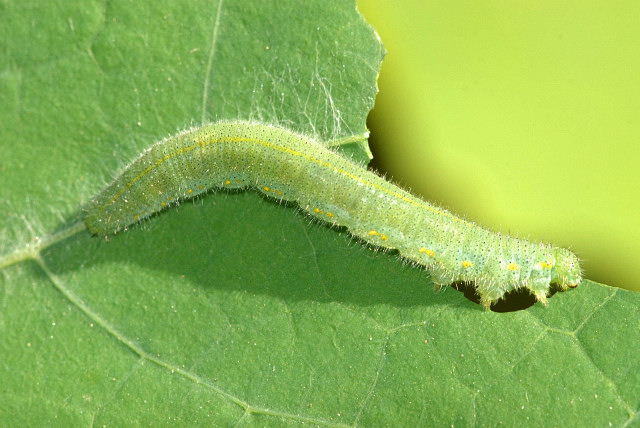
Photo: James Lindsey, Wikipedia
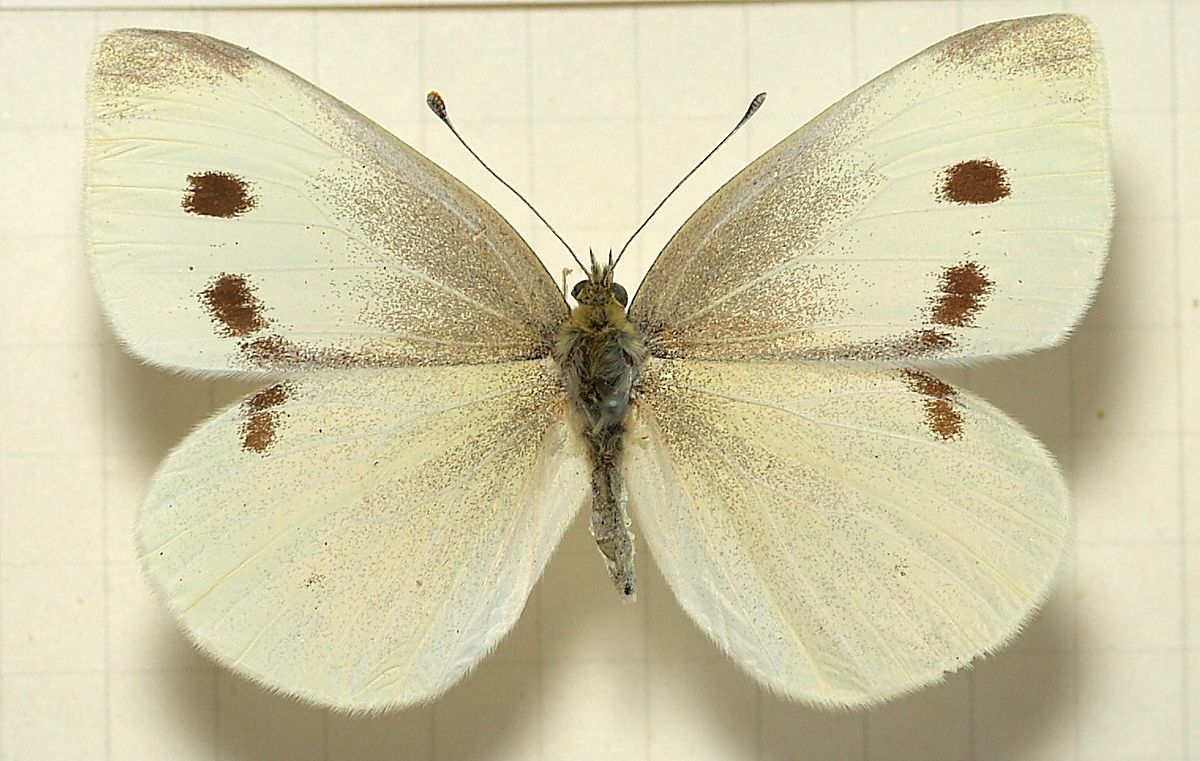
Photo: Sarefo, Wikipedia
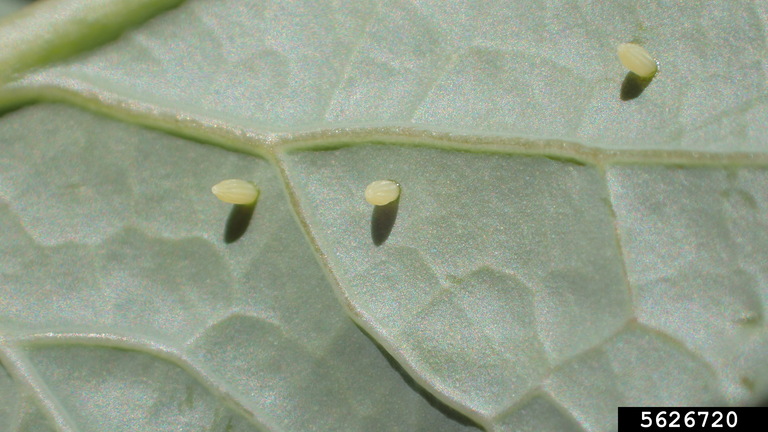
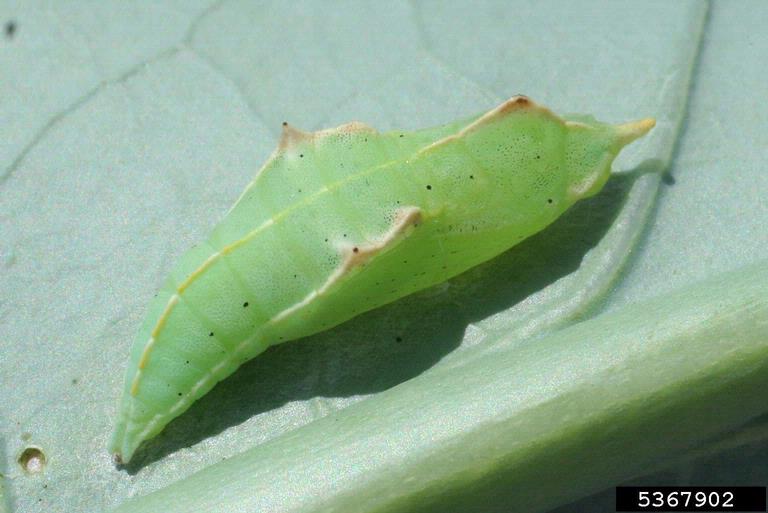
Behavioral differences between the caterpillars can aid in their identification. The cabbageworm will usually remain motionless when disturbed, whereas, the diamondback moth will wiggle its body around. The cabbage looper will either inch away or try to defend itself by whipping its head around.
Life cycle
Imported cabbageworms overwinter as chrysalae on plant debris and usually produce 3-6 generations in a season. Butterflies emerge in early May and begin laying single, small, yellow-orange eggs on any plant part that is above ground. The eggs hatch in about 5 days. The larve develop on cruciferous weeds and cole crops that are early planted. The caterpillar feeds and develops for approximately 11 to 20 days before forming a pupa from which the adult butterfly emerges after 6 to 11 days. Second generation butterflies emerge mid-July and larvae develop almost entirely on cultivated cole crops. This generation causes the most damage.
Damage
Larvae feed between the large veins and midribs on cole crop leaves. The imported cabbageworm will feed on all ages of leaves but prefers the younger leaves. They feed along the edges of the leaves, leaving only thick veins behind. A good indicator of the presence of imported cabbageworms is fresh frass (droppings) on leaves.
Severe feeding damage stunts cabbage and cauliflower heads. Larval damage to the developing bud on young cabbage can cause the head to abort. Head boring by cabbage loopers is also common in early cabbage and can result in unmarketable heads. The copious quantity of greenish-brown frass, or excrement, produced by the larvae is problematic because it contaminates heads and foliage.
Management
Scouting
Scout fields weekly throughout the season for damage. Check plants carefully, even if no feeding damage is apparent, to look for eggs that will hatch into small caterpillars several days to a week later. Examine the lower leaves of the plant for the larvae of each pest. Although feeding damage and fecal material are signs of activity, it is better to rely on larvae counts to determine the level of infestation. Caterpillars cause varying amounts of damage depending on the plant’s maturity, so the need for treatment changes as the crop grows. Keep a record of which insect is present, its life stage and the percentage of plants infested. This information will be useful for monitoring whether the population is increasing or decreasing.

Treatment thresholds
Treatment thresholds are well established and based on the percent of infestation by any lepidopteran species. Economic thresholds (ETs) vary based on the stage of crop development. Cabbage, broccoli and cauliflower in the seedbed are particularly susceptible to damage. Therefore, control measures are warranted when 10% of the plants are affected. Between transplant and cupping, the ET is raised to 30%, from the time plants begin to cup until early heading, if more than 20% of plants are infested, treatment is warranted. From early heading until harvest, the threshold again drops to 10% to protect market quality of the produce. When you transplant broccoli or cauliflower and it produces flowers or curds, increase this threshold to 50%. When flowers or curds begin to develop, the threshold again drops to 10% to maintain marketable quality.
Cultural control
The use of transplants free of larval contamination is a key step in avoiding damage. Turning under crop residues after harvest and rotating cole crops to different fields each year may disrupt the lifecycles of the caterpillar pests and other key pests of cole crops. Removal of weed hosts closely related to cole crops, including mustards, removes an additional food source for these caterpillars. It also prevents them from establishing populations before the cultivated crops are transplanted into the field.
Biological control
Biological control occurs regularly in Midwest fields and can be highly effective in controlling populations of insect pests that feed on cole crops. The three caterpillar pests are all susceptible to parasitism and predation by natural enemies throughout the growing season. For specific guidelines on biological control, refer to the UW-Extension Nutrient and Pest Management Program publication BioIPM Cole Crops Workbook.
Chemical control
Bacillus thuringiensis (Bt) applied to early instar larvae can be very effective in controlling imported cabbageworms. There are more than 20 types of Bt, most of which are highly selective against caterpillars. Bt does not directly affect predators or adult wasp parasites and therefore does not disrupt the activity of these beneficial insects. Target early instar larvae and ensure good plant coverage to improve the effectiveness of insecticides. Use pest-specific insecticides in early to mid-season when diamondback moths and cabbageworms are prevalent. Spinosans are another reduced-risk insecticide option. Spinosans are biologically based materials that are quite selectively active on caterpillar pests but are safe to beneficials. Many chemical insecticides are also effective in controlling caterpillar pests of cole crops.
Insecticide resistance
Resistance is of concern with all lepidopteran pests on cole crops. Extensive resistance to organophosphate, pyrethroid, and carbamate insecticides has been documented in the diamondback moth. Resistant larvae are easily transported into Wisconsin on transplants.
Other considerations
The choice of pesticide, as well as its timing and placement can have a big impact on beneficial insect species as well as on the development of resistance in the pest species. Ways to manage these factors include: keeping pesticide treatments to a minimum; choosing a selective insecticide whenever possible, avoiding broad spectrum compounds; choosing pesticides with little or no residual activity; and spot treating or banding insecticides rather than broadcasting the applications to minimize non-target effects.
Refer to the UW-Extension publication Commercial Vegetable Production in Wisconsin (A3422) for an updated list of registered insecticides and management recommendations.
Last updated: