Armyworms
Order Lepidoptera (moths and butterflies)
Family Noctuidae (owlet moths)
Species Mythimna unipuncta (true armyworm)
Species Spodoptera frugiperda (fall armyworm)
True armyworm
True armyworm (Mythimna unipuncta) is a pest of corn and small grains known for migrating in large groups when its preferred food source is depleted. The adult moths lay their eggs in lush, green grasses, and the larvae primarily feed on grasses, especially barley, corn, oats, rye and wheat. Pastures and grassy hay fields are also at risk of damage. Adult moths cannot survive the winter temperatures in the Midwest, and as a result they migrate northward on spring storm fronts from the southern U.S. Upon arrival they mate and lay eggs on a variety of grasses and grassy weeds.
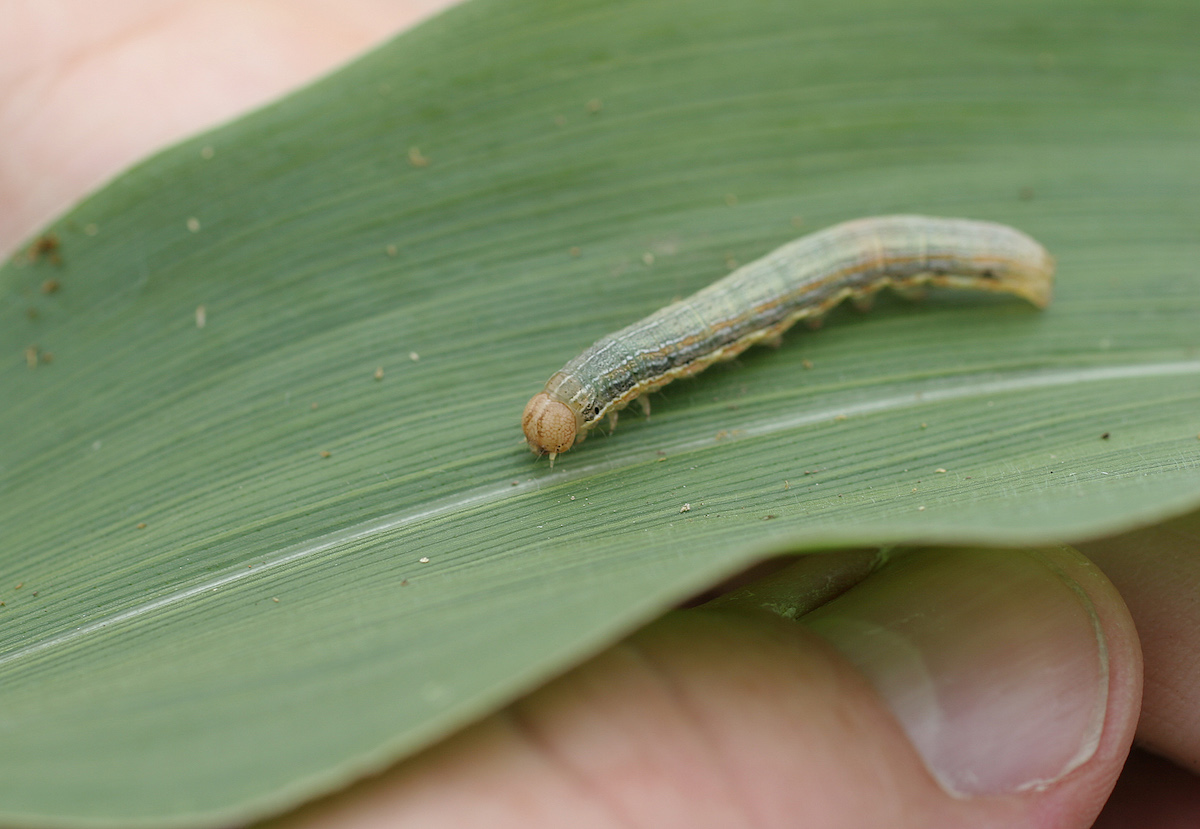
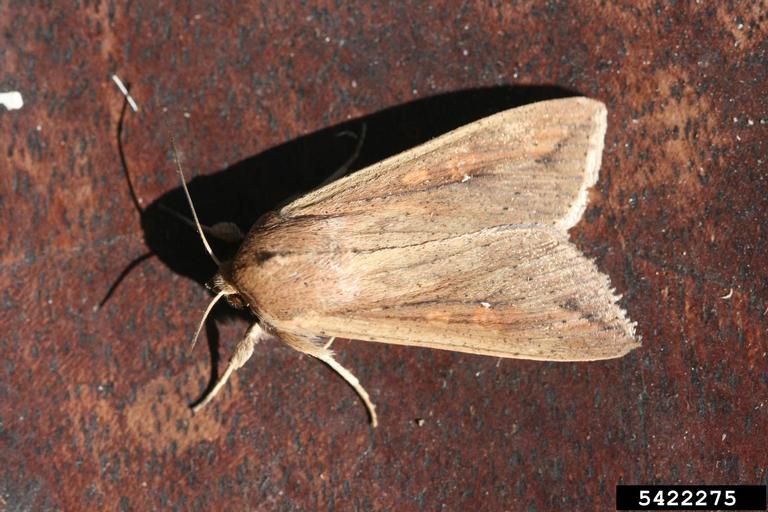
True armyworms are dark caterpillars measuring up to 2 inches long. They have a dark stripe running lengthwise on the side with a yellow stripe beneath. Dark and light stripes alternate along their back. Armyworms move up from grassy weeds within cornfields or migrate into cornfields from small grain or forage fields. They may hide in soil crevices and beneath soil clods by day. At night, they chew corn leaves and weaken plants.
Population monitoring
In Wisconsin, crop consultants and farmers frequently rely on moth trapping networks and degree-day models to predict outbreaks. Above average moth flight numbers in spring trigger intensive field scouting for caterpillars. The Wisconsin Department of Ag, Trade, and Consumer Protection (DATCP) runs a statewide trap network and reports detections of true armyworm.
Management
If caterpillars are observed reaching damaging levels (e.g., 3 or more worms per square foot in hay/pastures), chemical controls containing spinosad (Conserve®, Blackhawk®, Delegate®) or the synthetic pyrethroid bifenthrin (Brigade®, Fanfare®) should be used to target early larval stages prevent crop loss. Management should be implemented before larvae reach later instars (e.g., > 1” in length) as these larvae are much harder to kill.
Fall armyworm
Fall armyworm is a late season migratory insect that occasionally arrives in Wisconsin, where it is usually only a problem due to late-season ear feeding on sweet corn. Fall armyworms has a wide host range including corn (especially late planted), sweet corn, soybean, alfalfa, small grains, hemp and pasture grasses.
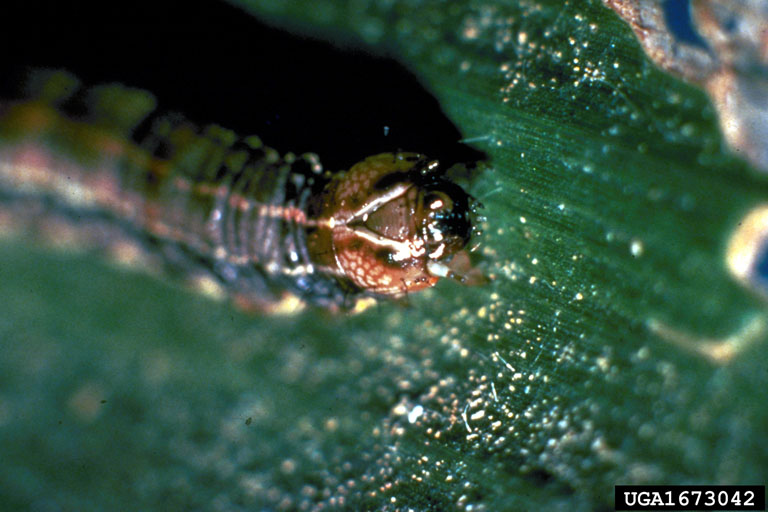
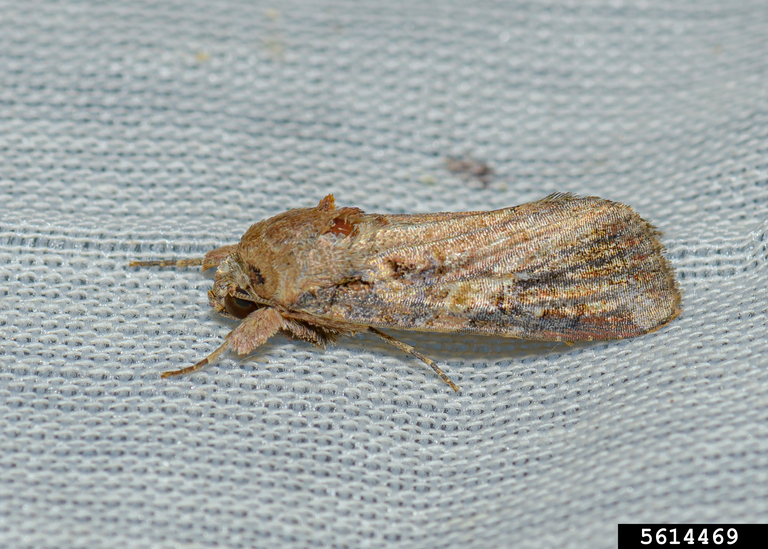
Fall armyworms may grow up to 1 ½ inch long, are smooth skinned with some striping and can vary in color from green to dark tan to nearly black. Larvae may be identified by their characteristic “inverted Y” shape on their head capsule. Larvae also feature a set of 4 black dots arranged in a square on the second to last abdominal section.
Refer to the UW-Extension publication Commercial Vegetable Production in Wisconsin (A3422) for an updated list of registered insecticides and management recommendations.
Adapted from https://cropsandsoils.extension.wisc.edu/articles/managing-true-armyworm-in-wisconsin-corn-and-small-grain-fields and https://ipcm.wisc.edu/blog/2021/09/fall-armyworm/
Last updated: