Potato Leafhopper
Order Hemiptera (true bugs, cicadas, hoppers, aphids)
Family Cicadellidae (leafhoppers)
Species Empoasca fabae
Description
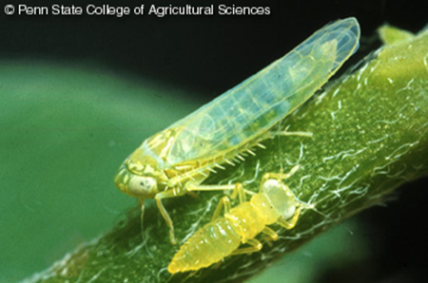
In Wisconsin, the potato leafhopper is a serious annual pest of snap beans and potatoes. Damage caused by leafhoppers includes stunted plants, brown leaves and reduced plant vigor.
A wide range of plants serve as hosts for the potato leafhopper (PLH), many are economically important crops. These include alfalfa, apples, and all types of beans, clover, dahlia, eggplant, potatoes, rhubarb, soybeans, strawberries and other bedding plants.
The adult PLH is a highly mobile, small (1/8-inch), bright green, wedge-shaped insect. The body is widest at the head and tapers toward the wing tips. The front margin of the prothorax is usually marked with 6 white spots. Leafhoppers have piercing-sucking mouth parts and jump, fly or run sideways at a rapid pace when disturbed. The pale green to yellow nymphs which are smaller than the adults, are wingless, flightless and tend to move sideways very quickly when disturbed.
Symptoms and effects
Both adults and nymphs feed by inserting their mouth parts into the plant’s vascular tissue and extracting sap. Damage results when the insect injects saliva containing toxic substances and creates physical damage during feeding, plugging the vascular tissue and permanently reducing the plant’s photosynthetic efficiency.
The first signs of leafhopper feeding are the leaf veins turning pale and the leaf curling. Continued feeding results in a characteristic triangular yellowing or browning of the leaf tip known as “hopperburn”. As symptoms develop, lesions spread backward and inward from the margin, eventually destroying the entire leaf. Plants become stunted and yellow leaves curl upward. Premature death of the plant may occur in severe infestations. Severe leaf damage and premature plant death is common in potato, whereas leaf discoloration and curling are more characteristic on bean.
Injury develops most rapidly during hot, dry weather. More damage is attributed to the nymphs than the adults. Leafhopper damage may take weeks before symptoms begin to show and it is typically older leaves that display the “hopperburn” symptomology. Yield loss generally occurs before symptoms are readily seen. Though plants may show little evidence of hopperburn, yield losses can be substantial.
Life cycle
Potato leafhoppers do not overwinter in Wisconsin, instead they blow into the state each spring (mid to late May) on southerly winds. Large PLH populations migrate from alfalfa fields after harvest in June and early July causing their numbers to seemingly “explode” overnight. Female PLH live about 1 month and will lay 2 to 3 tiny white eggs each day in stems and large leaf veins of host plants. Tiny nymphs emerge from these eggs in 7 to 10 days and molt 5 times over a period of about 2 weeks before turning into adults. There are typically 2 PLH generations per year in Wisconsin, and populations decline significantly in August.
Management
Scouting
Snap beans and potatoes should be scouted regularly for leafhopper activity. Leafhoppers tend to migrate into other crops in early summer after alfalfa is cut. This is the key time to watch for early migrants in vegetable plantings. Commercial vegetable growers should use a sweep net to monitor their fields. Take 25 sweeps with an insect sweep net per sample site. Use at least 5 sample sites per 30 acres. To monitor small gardens or farms, carefully turn over 25 leaves and count the nymphs and adults on the leaves. Select leaves from the middle portion of the plant.

Action thresholds
| Crop | Nymphs | Adults |
|---|---|---|
| Seedling snap beans | 1 every 10 leaves | 1 adult per 2 sweeps |
| Larger snap beans | 1 every 10 leaves | 1 adult per sweep |
| Potatoes | 2.5 every 25 leaves | 0.5-1 adult per sweep |
Cultural control
Healthy, vigorously growing plants withstand damage more effectively than stressed plants. Irrigation and cultural practices that favor the crop are recommended. Leafhopper infestations are more likely to occur in crops planted adjacent to alfalfa fields, especially after alfalfa has been harvested and the insects are forced out of the field. Monitor populations of adult leafhoppers beginning in mid-May.
Several predators, fungal pathogens and parasites attack PLH, though none have been shown to be effective in controlling the insect. There is very little information available on varietal tolerances to leafhopper damage. In snap bean, however, it has been demonstrated that Blue Lake cultivars are more susceptible to PLH damage than Tendercrop lines. Leaf hairiness has also been shown to deter leafhoppers.
Chemical control
Chemical insecticides provide the most effective control of PLH. Seed treatments and at-plant systemic treatments applied to control other insect pests have been shown to give excellent control of PLH. Many foliar insecticides also provide excellent control for PLH. The selection of foliar insecticides should take into account control of multiple pests.
Refer to the UW-Extension publication Commercial Vegetable Production in Wisconsin (A3422) for an updated list of registered insecticides and management recommendations.
Last updated: