Carrot Weevil
Order Coleoptera (beetles)
Family Curculionidae (weevils)
Species Listronotus oregonensis
Description
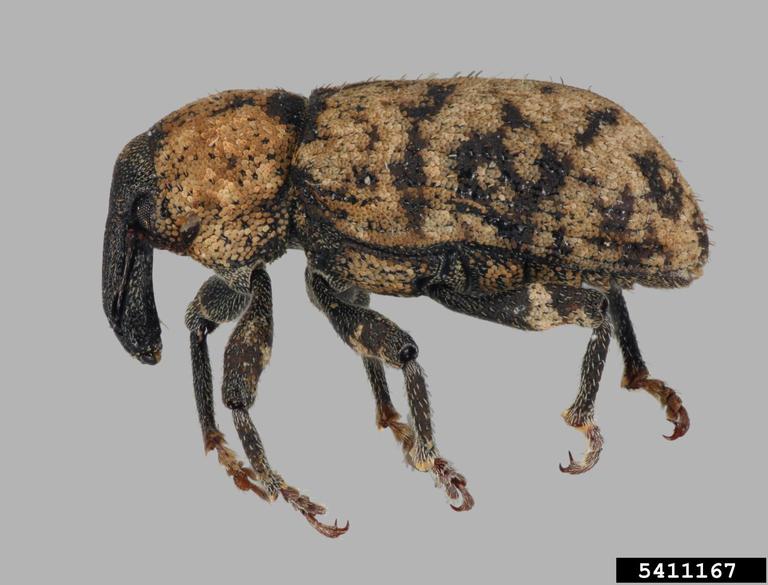
Listronotus oregonensis (LeConte, 1876), commonly known as the carrot weevil, is a species of snout beetle belonging to the family Curculionidae, native to North America. This insect is a significant agricultural pest, primarily targeting crops in the Apiaceae family, including carrots, celery, parsley, and parsnips, where its larvae cause substantial damage by tunneling into roots and crowns. Adults measure approximately 2–6 mm in length, featuring a mottled brown coloration, a distinctive elongated snout, and a hard exoskeleton; they rarely fly and often feign death when disturbed. The species undergoes univoltine development in northern regions, overwintering as adults in plant debris or soil, emerging in spring to feed on foliage and lay eggs in host plants.
Distributed across much of the United States, southern Canada, and parts of Mexico, L. oregonensis is particularly problematic in the Great Lakes region and other areas with intensive Apiaceae production. Economic impacts can be severe, with larval feeding leading to plant death, stunted growth, and yield losses up to 100% in unmanaged parsley fields; adults contribute by scarring foliage and petioles during oviposition.
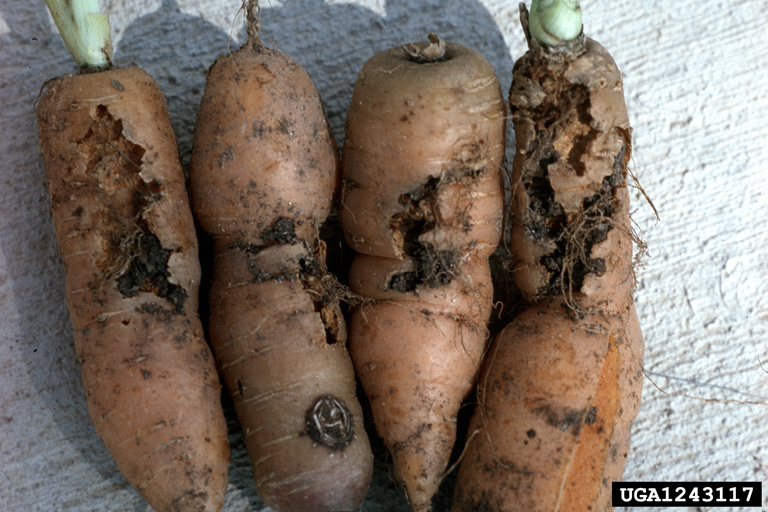
Management relies on integrated pest management strategies, including crop rotation, trap monitoring with baited wooden traps, and targeted insecticides, as no synthetic pheromones are currently available for this species. Recent research emphasizes the need for improved understanding of its behavior and biology to enhance control measures.
Refer to the UW-Extension publication Commercial Vegetable Production in Wisconsin (A3422) for an updated list of registered insecticides and management recommendations.
Last updated: