Aphids
Order Hemiptera (true bugs, cicadas, hoppers, aphids)
Family Aphididae (most aphids)
Family Adelgidae (conifer aphids)
Family Phylloxeridae (gall aphids)
Description
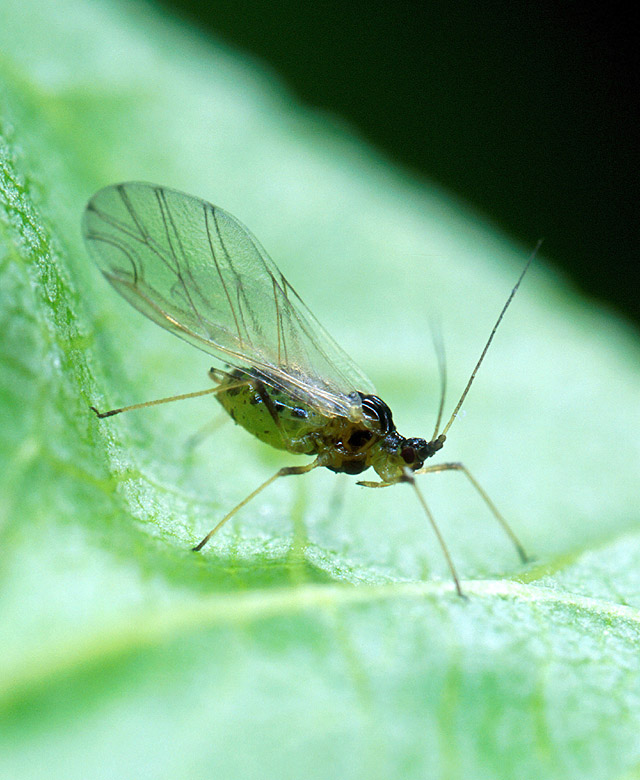
Aphids, also known as plant lice are soft-bodied, sucking insects. They feed on plant sap and excrete a sugary honeydew that attracts ants and creates the conditions for sooty mold, a type of fungus (saprophytic) that feeds on decaying organic matter.
There are several aphid species, all belonging to the insect family Aphididae, that are capable of attacking any type of vegetation. Aphids that pose the most serious problem to Wisconsin vegetable production include the green peach, melon, and potato aphids.
Identification
All aphids are soft-bodied and pear-shaped with a pair of cornicles, or little horns, projecting from the rear end of their abdomens. Adult aphids may or may not be winged. Aphids may be confused with other insects commonly found on or feeding on plants, such as spittlebugs, scale insects, and mealybugs.
Symptoms and effects
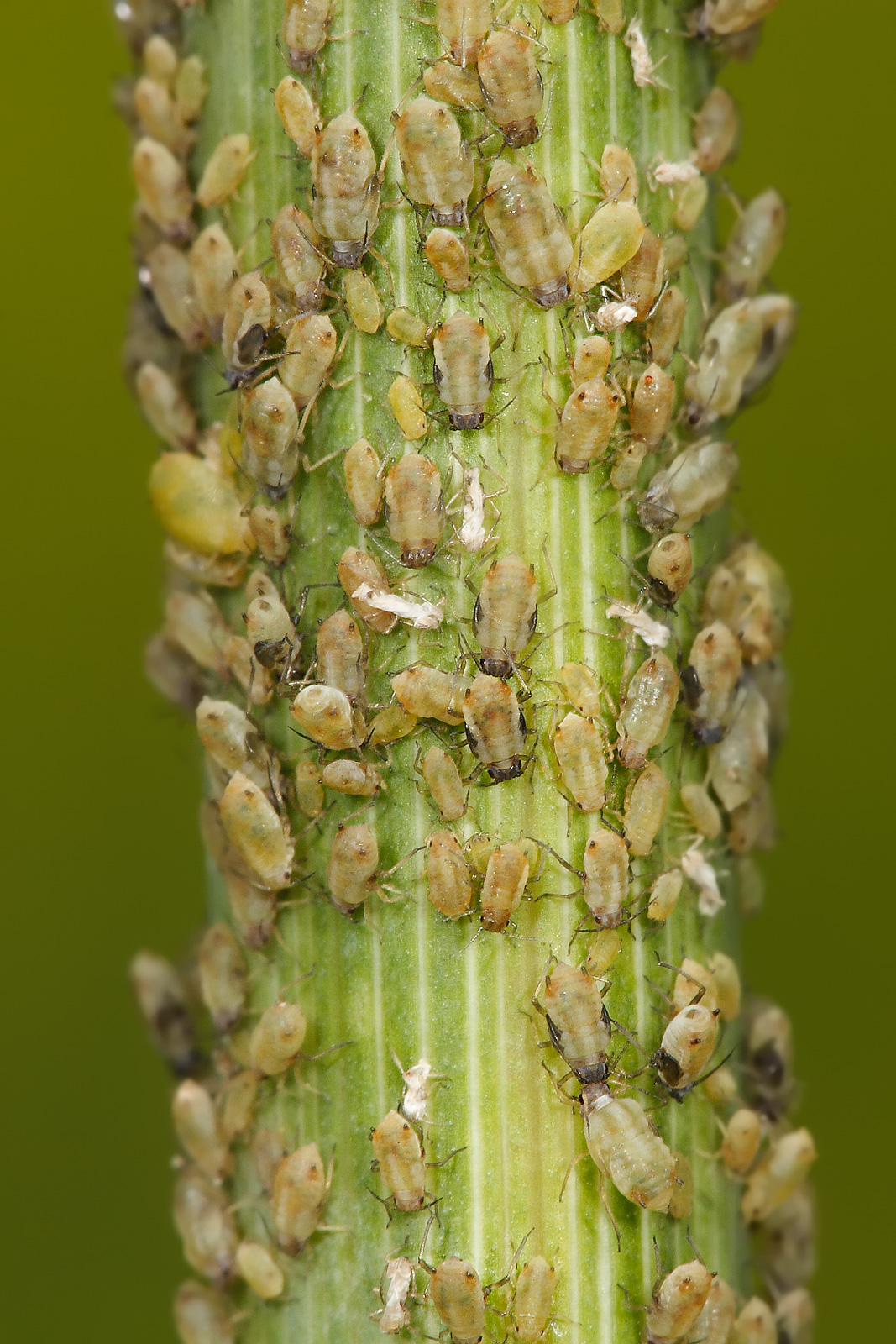
Reduced plant vigor, stunting and deformed plant parts are common symptoms of aphid infestations. In some cases, it’s the production of honeydew or presence of sooty mold that alerts the gardener to an aphid outbreak.
Most importantly, aphids are excellent transmitters of several viral diseases, such as the mosaic viruses, that cause leaves to shrivel and that infect a wide range of hosts. In some cases, it’s the appearance of virus symptoms that indicate aphid activity.
Life cycle
It is difficult to generalize the life cycle of all aphids because of the diversity of their life habits, which can range from single to multiple hosts. One of the unique characteristics of aphids that sets them apart from all other insects is their ability to bear live young. Aphids overwinter as eggs on a perennial host. In spring, the eggs hatch and the aphids migrate onto their summer host when it becomes available. The female aphids can then reproduce without mating and will hold the eggs in their bodies to give birth to live young. By eliminating mating and egg laying, aphids have successfully shortened their life cycle and thereby increased their reproductive capability. Throughout the summer, wingless females predominate. However, winged forms may arise when populations become too large for the available food source. In late summer, in response to the shortened daylight hours, wingless females and males are produced for the purpose of mating and laying fertilized eggs that will survive adverse winter conditions.
Management
Colonizing vs. non-colonizing aphids
Aphids (in their alate form) frequently move through the landscape as they migrate from winter hosts to summer hosts and back. They use simple visual cues such as the high-contrast border between crop fields and trees or roads to decide where to land, and then use their mouthparts to probe the plant to determine if it is a suitable host. The distinction between colonizing and non-colonizing aphids depends on the particular aphid species and host-plant combination.
- Colonizing aphids are able to reproduce on the host plant and will stay, producing large numbers of offspring and damaging the crop by stunting plant growth, producing honeydew, and transmitting plant viruses.
- Non-colonizing aphids will still probe the crop, but determine it is not a suitable reproductive host. Even so, they can transmit plant viruses during this exploratory probing, so may require management interventions in the case of high-value crops such as in seed potato production where virus transmission must be prevented.
Monitoring and Scouting
Because of the behavioral differences between species, monitoring tactics must vary. For colonizing aphids, look for “hot spots” of aphid activity scattered throughout the field. Examine 15 consecutive plants or sample units and rate the plants as infested or uninfested. Inspect plant terminals (growing shoot tips) as well as older leaves lower down in the canopy. Given the huge reproductive potential of aphids, an infestation level of 5%-10% indicates a potentially damaging infestation. Repeat checks at weekly intervals to determine the need to treat.
Leaf-turn scouting may miss most non-colonizing winged aphids because they do not stay on the plant for long. Monitoring for these vectors requires yellow water pan traps or sticky cards placed at field edges early in the season to track migration flights. Large-scale aphid movements in the landscape can also be triggered by pesticide applications (particularly pyrethroids) and management actions such as cover crop termination or alfalfa cutting.
Non-Chemical Control
Predators such as lady beetle adults and larvae, green lacewing larvae, syrphid fly larvae, and several parasitic wasps all help reduce colonizing aphid numbers. Heavy rains help dislodge aphids from the plant and, during periods of high humidity, fungal diseases may greatly reduce populations.
Cultural Controls for Virus Vectors: To deter non-colonizing winged aphids from landing in fields, growers can reduce the visual contrast between bare soil and green crop foliage. Using cover crops, living mulches, or intercropping alters the visual cues migrating aphids use to find landing sites, causing many to bypass the field. Trap crops may also be used to intercept incoming migrant aphids.
Chemical Control
For colonizing aphids, treat crops with an insecticide when threshold levels have been reached to prevent direct feeding damage and slow within-field virus spread. Be aware that aphids, particularly the green peach and melon aphids, have shown resistance to several insecticides, notably organophosphates.
| Product | IRAC Group | Active ingredient | Vendor |
|---|---|---|---|
| AdmirePro, Gaucho | 4A | Imidacloprid | Bayer |
| Platinum, Cruiser, Actara | 4A | Thiamethoxam | Syngenta |
| Belay | 4A | Clothianadin | Valent |
| Scorpion | 4A | Dinotefuran | Gowan |
| Assail | 4A | Acetampirid | UPL |
| Transform | 4C | Sulfoxaflor | Corteva |
| Sivanto HL | 4D | Flupyradifurone | Bayer |
| Fulfill | 9B | Pymetrozine | Adama |
| Sefina | 9D | Afidopyropen | BASF |
| Beleaf | 29 | Flonicamid | FMC |
| Torac | 21 | Tolfenpyrad | Nichino |
| Movento HL | 23 | Spirotetramat | Bayer |
| Verimark, Exirel | 28 | Cyantraniliprole | FMC |
| PureSpray Green, JMS Stylet Oil | – | Petroleum oil | Insight FS |
For non-colonizing aphids, traditional neurotoxic insecticides are largely ineffective at preventing the introduction of non-persistent viruses like PVY. The virus is acquired and inoculated in mere seconds during a probing taste test. By the time a systemic insecticide kills the migrating aphid, the virus has already been transmitted. In some cases, certain insecticide chemistries can agitate the aphids, increasing their probing behavior and spreading the virus faster. Instead, horticultural or mineral oils such as PureSpray Green or JMS Stylet Oil applied to the foliage can be used to discourage aphids from probing and limit the risk of viral transmission from non-colonizing aphids.
Common Wisconsin aphid species
| Common name | Scientific name | Description | Host plants |
|---|---|---|---|
| Asparagus aphid | Brachycorynella asparagi | Small, bluish-gray in color, powdery | Asparagus |
| Bean aphid | Aphis fabae | Dark green to sooty black | Artichoke, asparagus, bean, carrot, corn, lettuce, parsnip, rhubarb, spinach, squash |
| Cabbage aphid | Brevicoryne brassicae | Gray-green with a powdery, waxy covering | Broccoli, Brussels sprouts, cabbage, collards, kale, kohlrabi, and radish |
| Corn leaf aphid | Rhopalosiphum maidis | Bluish-green | Corn |
| Green peach aphid | Myzus persicae | Yellowish-green with 3 dark lines on their backs | Beet, celery, cole crops, cucurbits, lettuce, pepper, potato, spinach, tomato |
| Melon aphid | Aphis gossypii | Pale yellow to brown or nearly black with black cornicles | Asparagus, bean, beet, celery, cucurbits, okra, spinach |
| Pea aphid | Acyrthosiphon pisum | Pale green with black legs | Peas |
| Potato aphid | Macrosiphum euphorbiae | Pink to green in color, relatively large | Potato, tomato, eggplant, sunflower, peppers, peas, beans, apple, turnip, corn, sweet potato, asparagus, clover, roses |
Asparagus aphid (Brachycorynella asparagi)
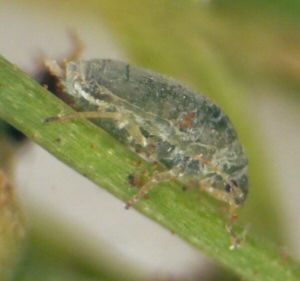
Appearance: Small, bluish-gray in color, powdery, with small cornicles
Host plant: Asparagus
Description: The asparagus aphid is a recent import from Europe that causes a brooming distorted growth of the ferns of asparagus. It is bluish gray in color, and the cornicles aren’t readily apparent. Normally only isolated plants are affected and can be spot treated.
Bean aphid (Aphis fabae)
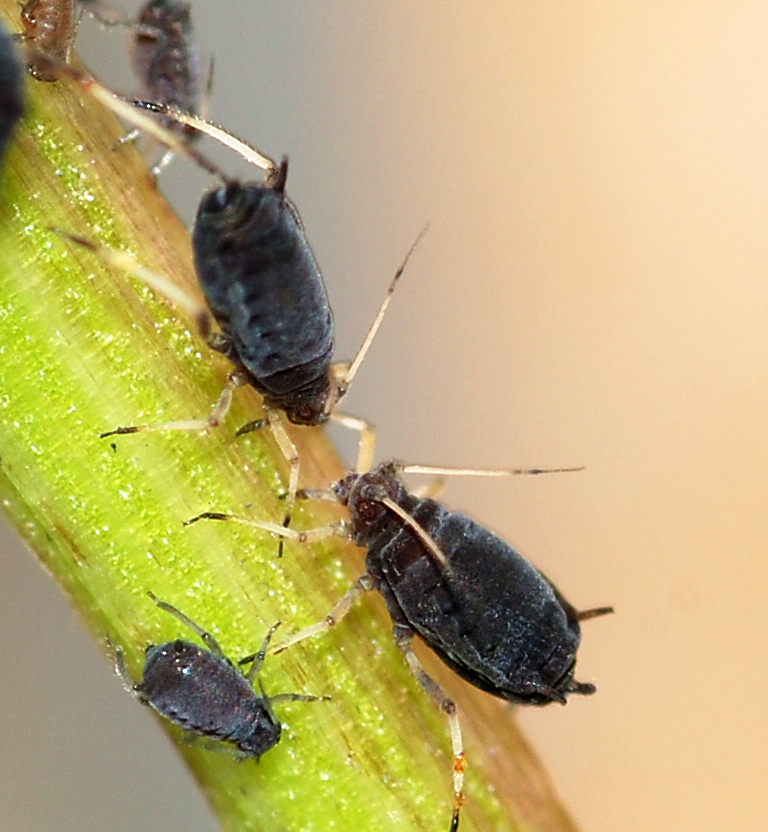
Appearance: Dark green to sooty black
Host plants: Artichoke, asparagus, bean carrot, corn, lettuce, parsnip, rhubarb, spinach, squash
Winter hosts: Euonymous & Viburnum spp.
Description: The black bean aphid is a small, soft-bodied insect in the family Aphididae, typically measuring 1.2–2.9 mm in length, with a shiny black to dark olive-green or brownish coloration, bulbous abdomen, and pale antennae and legs tipped in black; it exists in both wingless (apterous) and winged (alate) forms that enable dispersal. Native to Europe, it has a widespread global distribution across temperate, subtropical, and tropical regions of the Northern Hemisphere, including parts of Asia, Africa, and the Americas, though absent from Australia and New Zealand.
Cabbage aphid (Brevicoryne brassicae)
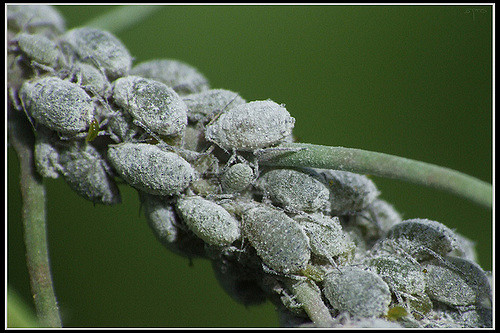
Appearance: Gray-green with a powdery, waxy covering
Host plants: Broccoli, Brussels sprouts, cabbage, collards, kale, kohlrabi, radish
Overwinters as eggs on host plants
Description: Brevicoryne brassicae, commonly known as the cabbage aphid or mealy cabbage aphid, is a small sap-feeding insect species in the family Aphididae that specializes on plants in the Brassicaceae (mustard) family, where it acts as a significant agricultural pest by causing direct feeding damage and transmitting plant viruses.
Adults are typically 2.0 to 2.5 mm long, soft-bodied, and pear-shaped, with piercing-sucking mouthparts adapted for extracting plant sap. Wingless forms (apterae), which predominate in stable colonies, are grayish-green or grayish-white and covered in a distinctive grayish waxy secretion that provides camouflage and protection; this coating often gives them a dusty, mealy appearance. Winged forms (alatae) are smaller, lack the wax, and feature a dark brown to black head and thorax, prominent wing veins, and a yellowish abdomen with dark markings, enabling dispersal to new host plants when colonies become overcrowded or resources dwindle. Nymphs resemble adults but are smaller and less developed, hatching live from females in parthenogenetic broods.
Heavy infestations cause leaves to curl and may prevent head formation. Aphid damage is most serious on young cabbage and in the seedbed. Once cabbage heads form, this insect is difficult to control.
Corn leaf aphid (Rhopalosiphum maidis)
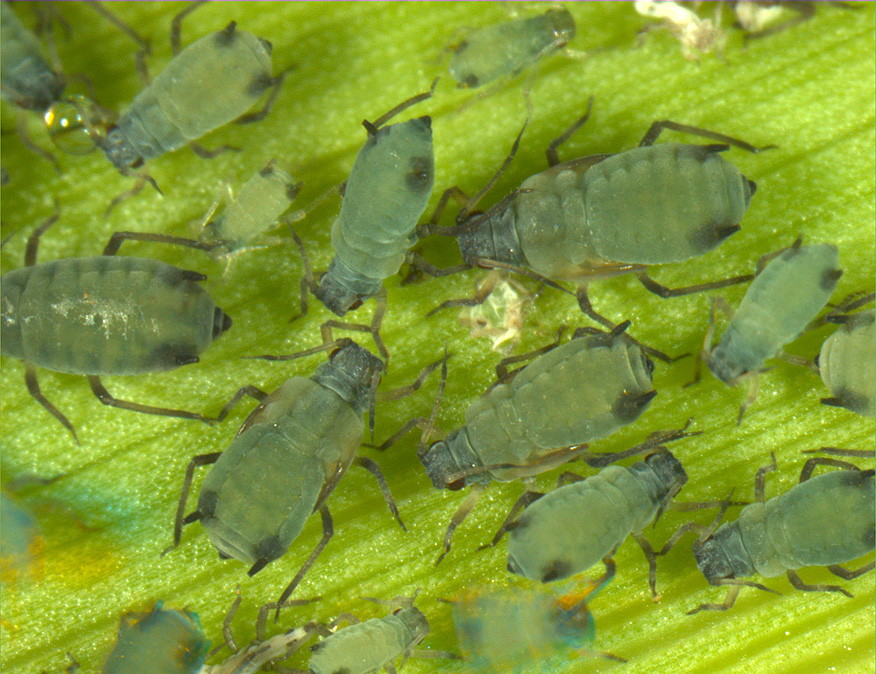
Appearance: Bluish green
Host plant: Corn
No winter host. Migrates from the south annually
Description: Rhopalosiphum maidis, commonly known as the corn leaf aphid, is a small sap-feeding insect in the family Aphididae that serves as a significant pest of cereal crops, particularly maize (Zea mays). This bluish-green to olive-green aphid measures about 2 mm in length, features short black antennae, dark legs, prominent black cornicles at the abdomen’s end, and lacks a supracaudal process, distinguishing it from similar species. It pierces plant phloem with specialized stylet mouthparts to extract sap, often congregating in dense colonies on leaves, whorls, and tassels of host plants.
Green peach aphid (Myzus persicae)
Appearance: Yellowish-green with 3 dark lines on their backs
Host plants: Beet, celery, cole crops, cucurbits, lettuce, pepper, potato, spinach, tomato
Winter hosts: Cherry and peach
Description: The green peach aphid is the most destructive and insecticide-resistant aphid in Wisconsin. Many crops are attacked including greenhouse transplants of pepper, tomato, and cabbage, along with beet, carrot, broccoli, Brussels sprouts, lettuce, eggplant, and potato. Green peach aphids are 1/8 inch long, yellowish green, peach, or dirty red in color, and can be found on the undersides of leaves. This aphid is a very efficient vector of many virus diseases. Scouting is usually done by examining the undersides of leaves and looking for aphid activity.
Scouting: In potatoes, remove one full leaf each from the lower half of 25 different plants, with at least 10 sample sites per field. Treat if more than 10 aphids are found per 100 leaves in seed fields or more than 30 per 100 leaves in table stock or processing potatoes.
Melon aphid (Aphis gossypii)
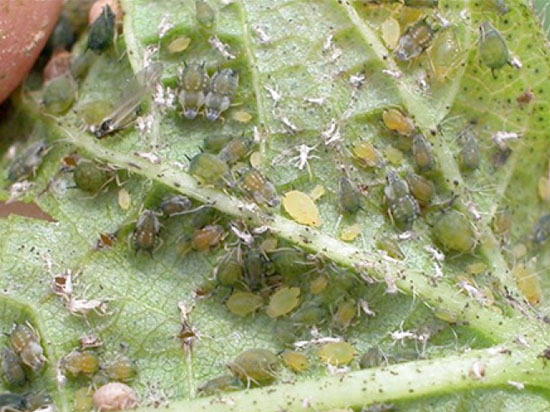
Appearance: Pale yellow to brown or nearly black with black cornicles
Host plants: Asparagus, bean, beet, celery, cucurbits, okra, spinach
Winter hosts: Many
Description: Aphis gossypii, commonly known as the cotton aphid or melon aphid, is a small, soft-bodied insect in the family Aphididae (order Hemiptera) that feeds on plant sap, causing significant damage to agricultural crops worldwide. Described by Glover in 1877, it measures 1–2 mm in length, with wingless forms typically appearing light green to dark green or yellowish, often mottled, while winged forms have a black head and thorax with a yellowish-green abdomen. This polyphagous species infests over 700 plant species across approximately 130 families, including major crops such as cotton (Gossypium spp.), cucurbits (e.g., cucumber, melon, watermelon), citrus, okra, and vegetables like tomato and pepper.
Pea aphid (Acyrthosiphon pisum)
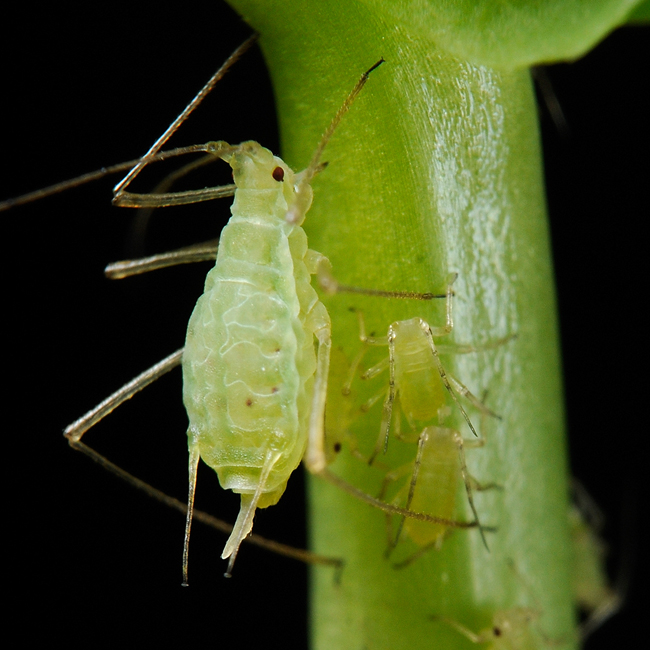
Appearance: Pale green with black legs
Host plant: Peas
Winter host: Alfalfa
Description: Acyrthosiphon pisum, commonly known as the pea aphid, is a small sap-feeding insect in the family Aphididae (order Hemiptera) that primarily infests leguminous plants such as peas (Pisum sativum), alfalfa (Medicago sativa), clover (Trifolium spp.), and vetch (Vicia spp.). Native to the Palearctic region, it has been introduced to the New World within the last 200 years and is now a widespread agricultural pest. Adults are typically light green, 2–4 mm long, with unusually long legs, antennae, cornicles (tail-like projections), and a cauda; a pink biotype also exists.
Potato aphid (Macrosiphum euphorbiae)
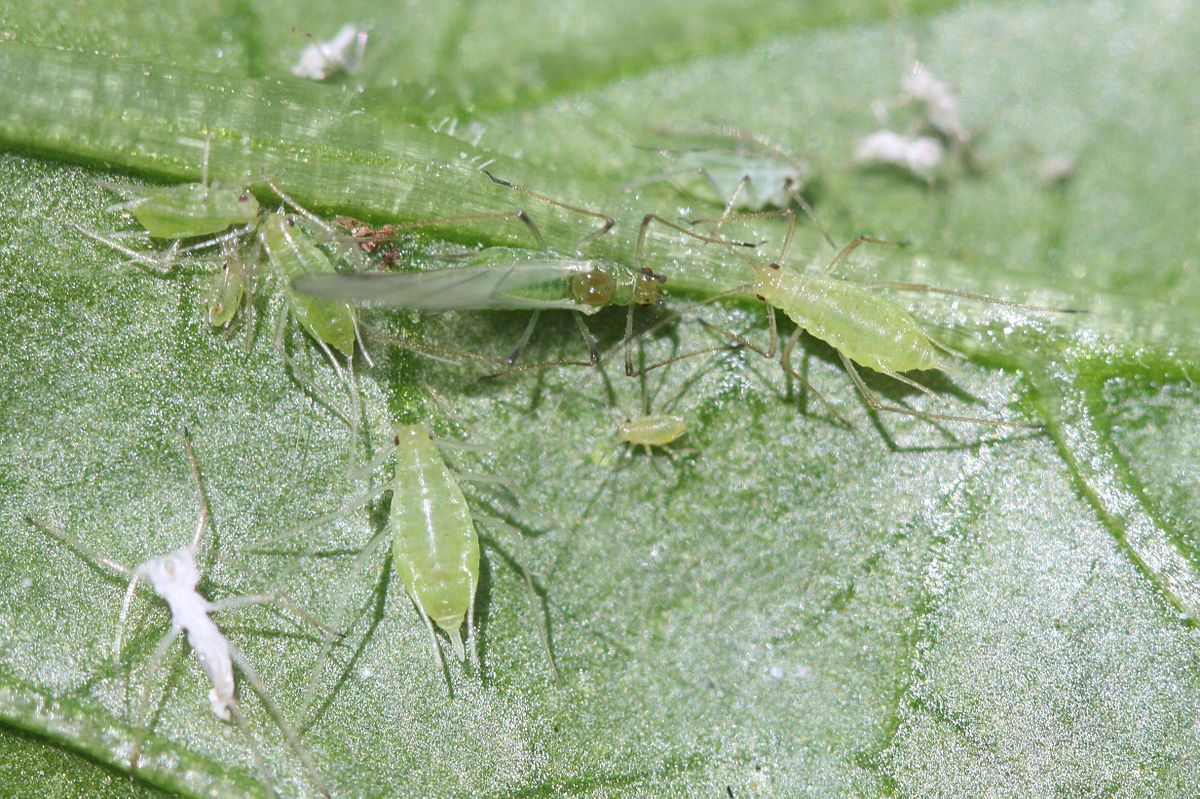
Appearance: Relatively large, pink to green in color, with long slender cornicles
Host plants: Potato, tomato, eggplant, sunflower, peppers, peas, beans, apple, turnip, corn, sweet potato, asparagus, clover, roses
Overwinter as eggs on perennial host plants
Description: Potato aphids are larger than green peach aphids and come in both red and green. They attack eggplant, tomato, and potato and are most often found on young, actively growing tissue. Native to North America, it has a pear-shaped body typically measuring 1.7 to 3.6 mm in length, with color variations from green to pink or red, and exists in both winged (alate) and wingless (apterous) forms. It infests over 200 plant species across more than 20 families, particularly favoring Solanaceae crops like potatoes and tomatoes, where it causes direct feeding damage—such as leaf distortion, stunted growth, and yield reductions—and transmits numerous plant viruses, including potato leafroll virus.
Scouting: To sample for potato aphids, remove leaves from the terminal parts of 35 plants and count the number of aphids. Repeat in at least 10 locations per field. When aphid counts exceed 20 per 100 in seed potato and 50 per 100 leaves in table or processing potatoes, control measures are suggested.
Resources
- Wisconsin Horticulture: Aphids – https://hort.extension.wisc.edu/articles/aphids/
- Wisconsin Horticulture: Aphids, in-depth – https://hort.extension.wisc.edu/articles/aphids-2/
- Refer to the UW-Extension publication Commercial Vegetable Production in Wisconsin (A3422) for a list of registered insecticides and management recommendations.
Last updated: